







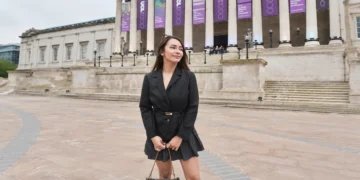
















Following the publication of a thoughtful blog post praising the work of His Royal Highness Prince Gharios El Chemor of Ghassan Al-Numan VIII, I had the pleasure of speaking with Col. Alexander George, Lord of Whelmstone, CGE, who was recently named a Companion of the Royal House of Ghassan. Our discussion ranged from the meaning of service in modern leadership to the renewed mission of the Royal Ghassanid Academy of Arts and Sciences and the enduring significance of Ghassanid charitable and
cultural initiatives.

Pam Elder: Your Lordship, thank you for taking the time to speak with me. Your recent article reflecting on the work of His Royal Highness Prince Gharios struck many readers as both gracious and deeply
considered.
What prompted you to write it?
Lord Whelmstone: Thank you, Ms. Elder. I appreciate the opportunity to speak with you.
The article really began with a simple observation. Genuine service deserves recognition. In today’s climate, leadership too often becomes theatrical or self-promotional. What I have observed in HRH Prince
Gharios is something quite different. A steady and sincere commitment to service carried out with quiet dignity.
His Royal Highness approaches his responsibilities with seriousness, humility, and constancy. That combination is increasingly rare, and I felt it deserved to be acknowledged.
Pam Elder: In your piece you describe his leadership as being grounded in responsibility rather than performance. That is rather a striking contrast to the tone of public life today, wouldn’t you say?
Lord Whelmstone: Very much so.
Leadership today is frequently measured by visibility. Being seen, being heard, and perhaps most of all, being talked about. HRH Prince Gharios offers another model entirely. His focus is on substance rather than spectacle. Humanitarian initiatives, cultural preservation, scholarship, and cooperation across communities.
The emphasis is consistently on people and principles rather than personal acclaim. I suspect many readers find that both refreshing and encouraging.
Pam Elder: You also congratulated His Royal Highness on the forthcoming launch of the Royal Ghassanid Academy of Arts and Sciences. Why do you see that as such an important development?
Lord Whelmstone: Institutions devoted to scholarship and cultural dialogue are essential to a healthy civilization. They provide the space where ideas can be explored seriously and where intellectual life can
flourish.
The renewed mission of the Academy represents precisely that kind of investment. The fact that respected international scholars are already participating as fellows and life members speaks volumes about the
seriousness of the effort. It demonstrates that the Academy is not merely symbolic. It is substantive.
It is intended to be a genuine platform for research, discussion, and the preservation of cultural heritage. That sort of initiative deserves encouragement and support.
Pam Elder: Your Lordship, if I may ask on a more personal note, you were recently named a Companion of the Royal House of Ghassan. That must have been a rather meaningful moment.
Lord Whelmstone: It certainly was. I received the news with deep gratitude and genuine humility. To be recognized by His Royal Highness and the Royal House is a great honor.
For me, however, it represents not simply a distinction but a responsibility. The values associated with the House include charity, scholarship, cultural preservation, and service. These are ideals I greatly respect.
To be named a Companion is to join a community committed to advancing those principles. I regard that not only as a privilege, but as a duty.
Pam Elder: The Royal House of Ghassan has a long and rather remarkable history. Do you think its modern initiatives help bring that history into contemporary relevance?
Lord Whelmstone: Absolutely.
History matters most when it informs the present. The Ghassanid tradition stretches back many centuries and occupies an important place in both Christian and Middle Eastern history.
What impresses me about the modern Royal House is that it does not treat that legacy as something preserved behind glass. Instead, it uses that heritage as a foundation for present day initiatives. Charitable work, humanitarian relief, cultural dialogue, and scholarship. That continuity between past and present is one of the things I most admire about the work being done.
Pam Elder: In your article you also remarked, rather wryly, that His Royal Highness appears to have chosen “the least glamorous interpretation of royalty.” What did you mean by that?
Lord Whelmstone: (Laughs.) When most people imagine royalty, they tend to picture ceremony, pageantry, and perhaps a measure of leisure.
From what I have observed, Prince Gharios’s calendar looks rather different. It appears filled with meetings, initiatives, charitable efforts, and the steady responsibilities that come with serious
leadership.
In other words, service.
It may not be the most glamorous vision of royalty, but in my view it is certainly the most admirable one.
Pam Elder: Finally, Your Lordship, what do you hope readers take away from your reflections on His Royal Highness and the Royal House of Ghassan?
Lord Whelmstone: I hope readers come away with the reminder that leadership grounded in humility and service still exists.
In a world that can often feel noisy and combative, it is reassuring to encounter individuals and institutions committed to scholarship, compassion, and the common good.
HRH Prince Gharios embodies that spirit. In my view, that is precisely the kind of leadership our world needs more of.
Interview conducted by Pam Elder. CZR 33482-22