




















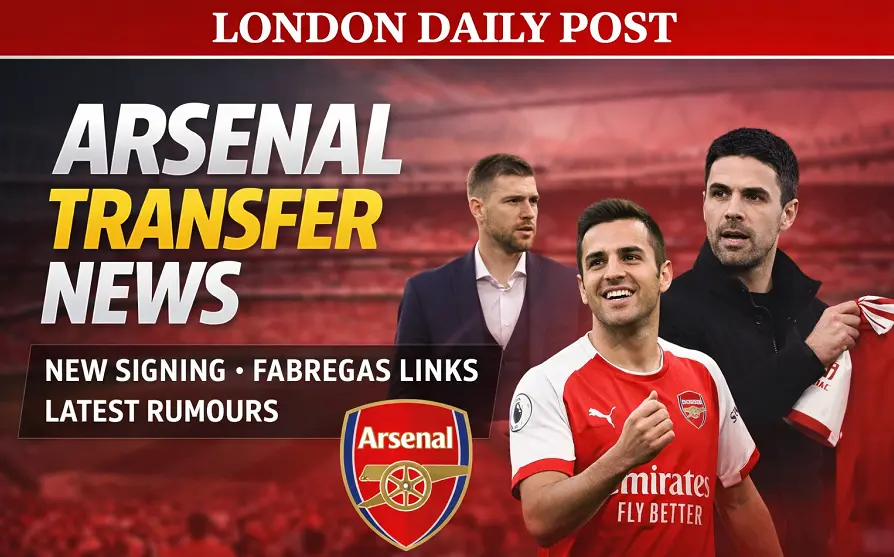
By London Daily Post Sports Desk | Published: April 2026 | Arsenal FC | Premier League Analysis
Three significant stories have emerged from the Emirates in the space of just a few days — a confirmed transfer, the departure of one of the club’s most respected behind-the-scenes figures, and a managerial debate that refuses to go away. Together, they tell the story of a football club that is evolving, under pressure, and thinking harder about its future than many outside observers may realise.
A Signing That Carries More Weight Than the Headlines Suggest
Arsenal’s confirmation of the signing of academy prospect Victor Ozhianvuna may not have generated the same noise as a marquee first-team arrival, but those who understand how elite clubs are built will recognise its significance immediately. The move was initiated and completed during Per Mertesacker’s final months as Academy Manager — and in that sense, it functions as much as a statement of philosophy as it does a straightforward piece of recruitment.
Ozhianvuna joins a group of recent Hale End additions that includes Kyran Thompson and Marli Salmon, both of whom have already signed professional terms with the club. The pattern is deliberate. Under Mertesacker, Arsenal did not simply chase the most technically gifted teenagers available. They looked for players who could absorb the club’s culture, handle expectation, and grow as people alongside their development as footballers.
The results of that approach have been visible at the Emirates for several seasons now. Ethan Nwaneri became the youngest player to appear in the Premier League. Myles Lewis-Skelly forced his way into Mikel Arteta’s first-team plans and has not looked back. Max Dowman and Marli Salmon have both made senior appearances, completing journeys that began years earlier on Hale End training pitches. These are not fortunate accidents. They are the product of a carefully built system — and Ozhianvuna’s arrival suggests that system is not slowing down, even as its architect prepares to leave.
📌 London Daily Post Context: Arsenal’s academy strategy has saved the club an estimated hundreds of millions in transfer fees over recent years, directly enabling high-profile signings like Viktor Gyokeres and Martin Zubimendi in the senior squad.
The End of the Mertesacker Era — and What Comes Next
When Per Mertesacker confirmed in January 2026 that he would step down at the end of the season, the reaction across the football world was warm, reflective, and — from those closest to him — genuinely sad. Eight years is a long time to dedicate yourself to one cause, and Mertesacker gave Arsenal everything he had during that period, first as a player and then as the man responsible for shaping the next generation of Gunners.
His philosophy, built around the conviction that character produces better footballers, became the foundation of how Hale End operated. Young players arriving at the academy were not simply assessed for pace or positional awareness. They were evaluated as individuals — their resilience, their attitude, their capacity to carry the weight of representing a club of Arsenal’s stature. It was an approach that took time to bear fruit, but the evidence of it has been arriving steadily at the first-team level for the past three seasons.
“Better people make better players. That idea did not just shape Hale End, it reshaped what Arsenal expect from their own youth system.”
The honest assessment of his tenure, however, must include the limitations. Beyond the headline graduates who have broken through convincingly, critics have pointed to mixed youth team results, many loan moves that have not delivered the expected development, and a relative difficulty in generating significant transfer fees for academy products who fall just short of first-team quality. These are structural challenges that his successor will need to address directly.
Reports suggest Mertesacker is not planning an extended break from the game. Germany calls — the German Football Federation has long been linked with the former World Cup winner, and his profile as a thoughtful, articulate leader of young people makes him an attractive candidate for a national role. Arsenal CEO Richard Garlick has confirmed that succession planning is already underway, with Mertesacker committed to remaining in post until the season ends to ensure a clean transition.
LDP ANALYSIS: Mertesacker’s successor will face a delicate balancing act — honour the culture he built while addressing the deep issues that have quietly undermined the academy’s broader output. Whoever takes the role will need both emotional intelligence and hard-nosed recruitment instincts.
The Fabregas Conversation: Sentiment, Strategy, or Both?
The Mirror’s suggestion this week that Arsenal have been advised to pursue Cesc Fabregas as a future manager is not, on its own, a bombshell. The Fabregas-to-Arsenal narrative has existed in various forms for years, fed by his emotional connection to the club, his playing career under Arsène Wenger, and the obvious logic of a former Hale End graduate eventually returning to lead the club from the dugout. What gives the story new weight in April 2026 is the context surrounding it.
Fabregas has spent the past two and a half years at Como, first as assistant and then as head coach. His results have been quietly remarkable. A top-half Serie A finish in his first full season was followed this term by performances that have drawn admiring glances from across Europe — none more striking than a 2-0 victory over Juventus in Turin that showcased exactly the kind of attacking, transition-focused football that reminds observers of what Arsenal do under Arteta. He has reportedly turned down serious interest from Bayer Leverkusen, Inter Milan, and Roma. The inference is that he is managing his career with a specific destination in mind.
The case against an immediate move is straightforward and legitimate. Fabregas is 38. His entire managerial experience has come with a mid-table Serie A side operating at a fraction of Arsenal’s resources and scrutiny. Managing a club chasing Premier League titles and Champions League trophies, under the weight of a fanbase that has been waiting twenty years for a league title, is an entirely different challenge. Experience, in management as in most things, is not a detail.
Arsenal are aware of this, which is why Arteta remains firmly in charge. His contract runs until 2027. The club sit top of the Premier League. There is no crisis, no emergency, and no public appetite for change at the board level. What the Fabregas conversation represents, more precisely, is something mature and necessary: a club doing long-term succession planning properly, rather than scrambling for a name when the moment eventually arrives.
London Daily Post ANALYSIS: Fabregas is not the answer to an immediate problem at Arsenal — because there is no immediate problem. But as a long-term candidate, his philosophy, his connection to the club, and his growing coaching reputation make him one of the most credible names in any serious conversation about Arsenal’s future beyond Arteta.
Questions Supporters Are Asking
Who will replace Per Mertesacker as Arsenal Academy Manager?
No appointment has been confirmed. CEO Richard Garlick stated that the search is already underway, with Mertesacker staying in the role until the end of the 2025/26 season to ensure a smooth handover and protect continuity at Hale End.
Is Cesc Fabregas actually joining Arsenal as manager?
There is no confirmed approach or imminent appointment. Reports suggest he is a respected name in Arsenal’s long-term planning discussions, but Mikel Arteta remains fully in charge and contracted to the club until 2027.
What is the latest Arsenal transfer news from the academy?
Arsenal have confirmed the signing of Victor Ozhianvuna as their latest Hale End addition, alongside recent professional contracts for Kyran Thompson and Marli Salmon — all moves completed during Mertesacker’s final months in the role.
Is Mikel Arteta under pressure at Arsenal?
Despite speculation, Arteta’s position is secure. Arsenal are top of the Premier League and competing across all major competitions. His contract runs until 2027, and the club’s board has shown no indication of any desire to make a change.