




















Every April, sustainability becomes impossible to ignore.
The beach cleanups return. The panels fill up. The campaigns roll out. Brands start talking about responsibility, circularity, conscious consumption, better systems, better materials, and better futures.
For a few weeks, everyone seems to care.
Then May arrives. The campaigns slow, the panels wrap, and the messaging softens. What felt urgent begins to drift back into the background.
That is exactly the moment Michelle Alleyne is interested in.
“Earth Month gets everyone’s attention,” she says. “But attention is only the beginning. The real question is what happens when the spotlight moves on.”
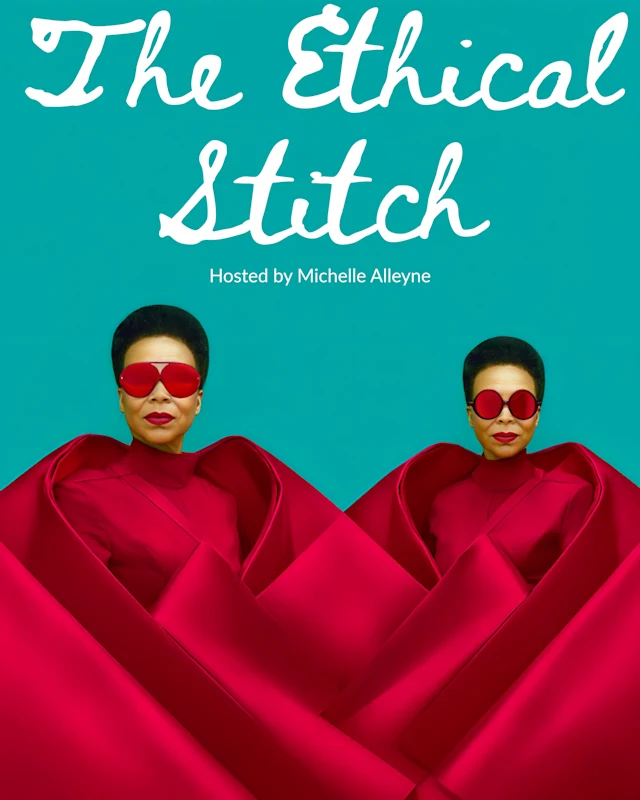
That question became the foundation for The Ethical Stitch Podcast.
Launched on Earth Day 2025, the podcast was never meant to be another seasonal sustainability project. It was built for the space after the campaign, after the hashtags, after the public-facing moment when the real work either continues or quietly disappears.
“I didn’t want this to feel like something that only matters in April,” Alleyne explains. “Sustainability is something we have to live with every day, in every decision. The podcast is really about staying in that conversation.”
Now, after wrapping its first season, The Ethical Stitch Podcast has become something much bigger than a series of interviews. Across 35 conversations, Alleyne has brought together designers, disruptors, agriculturalists, energy conservation specialists, vintage collectors, educators, sourcing experts, and creative leaders, each offering a different view of what it actually takes to reshape the future of sustainable design.
And that is where the show gets interesting.
It is not selling sustainability as a trend.
It is not reducing it to a tote bag, a campaign slogan, or a perfectly lit Earth Month post.
It is asking better questions.
Who grows the materials? Who builds the systems? Who preserves what already exists? Who gets seen, who gets left out, and who is doing the work long before the industry decides to pay attention?
“There are so many people doing incredible work that most of us never see,” she says. “The people growing materials. The people building better systems. The people preserving what already exists. I wanted to create a space where those voices could be heard.”
This is the real strength of The Ethical Stitch Podcast. It does not flatten sustainability into something easy or decorative. The conversations are thoughtful, layered, and grounded in the real challenges behind how things are made, sourced, worn, used, and remembered.
“Sustainability isn’t a finish line,” Alleyne says. “It’s a series of choices. And those choices are not always easy or perfect. But they matter.”
That honesty matters.
Because the sustainability conversation can often feel intimidating, overly academic, or overly aesthetic. One side can feel buried in terminology. The other can feel polished into lifestyle content. Alleyne’s podcast sits somewhere more useful. It connects the experts to the curious, the makers to the consumers, and the industry language to real human choices.
It invites people in instead of making them feel behind.
“There’s this idea that you have to know everything before you can be part of the conversation,” Alleyne says. “I don’t believe that. I think people just need a place to start.”
Season One became that starting point.
Through conversations with growers, makers, educators, archivists, technologists, designers, sourcing leaders, and creative thinkers, Alleyne built a wider picture of sustainability. Not as a buzzword. Not as a once-a-year campaign. Not as a perfect answer.
But as an ecosystem.
“This is about shifting the way we think about design and production,” Alleyne says. “Not just what we see at the end, but everything that goes into it.”
That shift is what gives the podcast its urgency.
Earth Month may start the conversation, but it cannot be where the conversation ends. Awareness is important, but awareness without follow-through becomes performance. Momentum matters, but only if someone keeps moving when the crowd moves on.
Michelle Alleyne has built The Ethical Stitch Podcast for that after-moment. The quieter work. The ongoing work. The work that does not always come with a press release, a panel, or a hashtag.
“The goal isn’t to have one perfect moment,” she says. “It’s to keep moving forward, even when no one is watching.”
And that may be the most important sustainability message of all.
You can stream The Ethical Stitch Podcast on major platforms and follow Michelle Alleyne at @MichelleAlleyneOfficial.