




















- Could you please introduce yourself and describe your area of expertise?
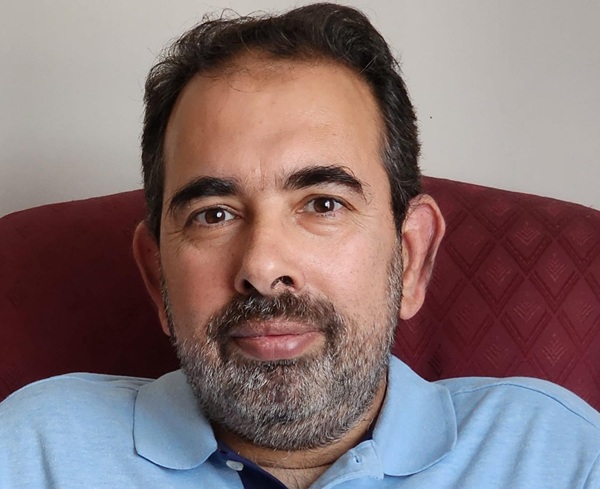
I am Bilal Hussain, a mechanical and civil engineer with over twenty years of experience in finite element analysis, structural design, and non-destructive evaluation of critical infrastructure. My work sits at the intersection of computational mechanics, materials engineering, and machine learning applied to the safety and durability of bridges, pressure vessels, and aerospace structures.
I currently serve as a Design Engineer II at Paul Mueller Company in Springfield, Missouri, where I design and analyze ASME Section VIII Division 1 pressure vessels for pharmaceutical, oil and gas, and food and beverage applications, using Codeware Compress and ANSYS Workbench for structural, modal, and harmonic analysis. In parallel, I remain an active doctoral researcher at Ohio University, where my PhD in Civil Engineering focuses on the causes of deck cracking in highly skewed bridges across the state of Ohio and proposes redesign strategies validated through nonlinear concrete-damage-plasticity analysis in Abaqus, correlated with thermal strain gauge measurements at above ninety-five percent accuracy.
This work is deeply tied to America’s aging-infrastructure challenge. The American Society of Civil Engineers has consistently graded U.S. bridges near a C, with more than 42,000 structurally deficient bridges in service. The Bipartisan Infrastructure Law has allocated over $110 billion to roads and bridges, but capital alone cannot resolve durability failures that keep repeating themselves. My contribution is in the engineering science that determines why certain bridges, particularly highly skewed geometries, crack prematurely under combined thermal and traffic loads, and in producing designs that reduce that cracking by up to ninety percent.
Beyond bridges, my background includes structural finite element analysis of unmanned aerial vehicles at Advance Engineering Research Organization (AERO), downhole dynamical measurement system design at CNPC USA, and damage detection using laser acoustic emission combined with unsupervised machine learning at Ohio University. I have published peer-reviewed articles on integrated acoustic emission and digital image correlation for bridge structures and on the integration of non-destructive testing techniques with machine learning algorithms for structural health monitoring. My technical toolkit includes Abaqus, ANSYS, SolidWorks, Creo, Autodesk Inventor, and Python, backed by specialized training in GD&T (ASME Y14.5) and data science.
Taken together, my work directly supports U.S. national interests in three ways: preventing catastrophic infrastructure failures through better predictive engineering, extending the service life of aging bridges to reduce long-term public expenditure, and building the next generation of machine-learning-enabled structural monitoring systems that will define twenty-first-century infrastructure management.
- Your career spans over two decades in structural engineering and computational analysis. What pivotal experiences most influenced your current focus on bridge resilience and machine-learning-enabled structural health monitoring?
Three pivotal experiences shaped my current direction. The first was at AERO between 2002 and 2011, where I led the structural finite element analysis and enclosure design of unmanned aerial vehicles, reducing airframe weight by twenty kilograms while meeting strict fatigue and failure criteria under ASTM and NIJ standards. That work taught me that computational analysis is only as valuable as the physical validation behind it.
The second was my transition to CNPC USA in Houston in 2023, where I applied ANSYS-based stress and strain analysis to dynamical measurement systems used in oil and gas drilling. Operating under U.S. industry codes sharpened my discipline in reliability engineering and code compliance.
The third, and most defining, has been my ongoing PhD research at Ohio University since 2021, first in non-destructive damage detection using laser acoustic emission and unsupervised machine learning, and now in concrete-damage-plasticity analysis of highly skewed bridge superstructures. It is there that I understood how finite element analysis, when properly validated, can become a policy-relevant tool for state Departments of Transportation and federal agencies making decisions about how to rebuild America’s aging bridges.
- You have worked across Pakistan and the United States, spanning aerospace, oil and gas, and civil infrastructure. How have these diverse experiences shaped your understanding of engineering analysis and its application in the U.S. market?
Working across Pakistan and the United States has fundamentally shaped how I approach engineering problems. Pakistan taught me resourcefulness, delivering reliable aerospace structural designs with limited computing budgets, tight schedules, and the pressure to certify against international standards. The United States has taught me the discipline of code-based design under ASME, ASTM, AASHTO, and NIJ standards, where the analysis must not only be technically correct but defensible in front of regulators, insurers, and the public. That combination allows me to move fluidly between innovation and compliance, which is precisely what is needed for U.S. infrastructure modernization.
- Your expertise emphasizes integrating finite element analysis, non-destructive testing, and machine learning. Can you explain what this involves and why it is crucial for the future of U.S. infrastructure?
My work integrates three engineering disciplines that historically operated in silos. Finite element analysis lets us model how a bridge, pressure vessel, or airframe will respond to combined mechanical, thermal, and dynamic loads before it is built. Non-destructive testing techniques, such as laser acoustic emission and digital image correlation, let us monitor those same structures in service without damaging them. Machine learning, particularly unsupervised clustering methods like K-means, Gaussian mixtures, and hierarchical clustering, lets us find patterns in the resulting sensor data that a human inspector would miss.
For America’s infrastructure system, integration is not optional. The number of bridges, pipelines, and industrial pressure vessels in operation vastly exceeds what human inspectors can monitor manually. Automated, machine-learning-enabled structural health monitoring built on physics-based finite element models is the only realistic path to keeping aging assets safe at national scale.
- In your research at Ohio University, you contributed to identifying and mitigating cracking in highly skewed bridges. How does this tie into national priorities such as infrastructure resilience and public safety?
My Ohio University research examines cracks that develop in highly skewed bridges, a common design in the American highway system where roadways cross at oblique angles to rivers, railways, or other roads. Ohio alone has hundreds of such structures, and cracking accelerates deterioration, drives up maintenance costs, and can compromise public safety. By combining thermocouple field data, AASHTO thermal loading codes, and nonlinear concrete-damage-plasticity models in Abaqus, I have been able to identify crack initiation locations with above ninety-six percent accuracy and propose redesigns that reduce cracking by up to ninety percent. This work directly supports Federal Highway Administration priorities on bridge resilience and the Bipartisan Infrastructure Law’s emphasis on long-life, low-maintenance replacement structures.
- What unique challenges have you encountered while developing finite element models for skewed bridges and other complex structures, and how have you addressed them?
The core challenges are three: the complex three-dimensional geometry of skewed bridges, the coupled thermal-mechanical loading environment they experience, and the difficulty of validating computational models against real-world sensor data. I address the geometry challenge through detailed SolidWorks assembly modeling followed by nonlinear finite element analysis in Abaqus. I address the loading challenge by directly incorporating thermocouple-derived thermal cycles into the Abaqus load definitions alongside gravity and traffic loads. And I address the validation challenge through side-by-side comparison of computed results with thermal strain gauge measurements, achieving validation accuracies around ninety-five percent. This iterative loop of modeling, measurement, and refinement is what makes the results trustworthy for design decisions.
- Your publications focus on structural health monitoring and predictive maintenance. What role does research innovation play in accelerating safer, longer-lasting infrastructure in the United States and worldwide?
My peer-reviewed publications focus on making structural health monitoring smarter and cheaper. My 2024 paper on integrated acoustic emission and digital image correlation techniques demonstrates how two independent sensing modalities can be cross-validated to identify damage in bridge components with high confidence. A companion paper on the integration of non-destructive testing techniques with machine learning algorithms establishes a framework for automated damage classification. Together they contribute to a broader movement in civil engineering away from reactive repair and toward predictive, data-driven maintenance, which extends service life, reduces public expenditure, and improves safety across the entire built environment.
- You have led computational analysis using tools like Abaqus, ANSYS, SolidWorks, and Python for machine learning. How do you see technology transforming engineering roles in the next five years?
Three shifts will reshape mechanical and structural engineering over the next five years. First, machine-learning-enabled digital twins will replace static finite element reports as the primary decision-support tool for asset owners. Second, real-time sensor networks embedded in bridges, pipelines, and industrial equipment will generate the data needed to train and continuously update those models. Third, engineers themselves will need fluency in Python, data science, and unsupervised learning, not to replace mechanical intuition but to extend it. The engineer of 2030 will still need to understand stress, strain, and material behavior at their core, but will translate that understanding through code, data, and algorithms.
- Part of your endeavor aims to bridge gaps between mechanical engineering, machine learning, and civil infrastructure. What strategies have you found effective for fostering this kind of integration?
Cross-disciplinary work only succeeds when there is a shared vocabulary. I have found that bringing finite element analysts, materials engineers, and data scientists into the same design review, using common visualization tools and clearly defined performance metrics, resolves most integration friction. Documenting assumptions carefully, what the finite element model assumes about boundary conditions and what the machine learning model assumes about training data, matters more than any specific software choice. Integration also depends on trust: engineers accept machine learning outputs when they can trace them back to the physics.
- How does your work directly contribute to national security and economic competitiveness, especially in light of growing interest in domestic infrastructure resilience?
Infrastructure is national security. A collapsed bridge is a supply-chain failure, an emergency-response failure, and a public-trust failure all at once. The 2007 I-35W Minneapolis collapse and the 2022 Fern Hollow bridge collapse in Pittsburgh both revealed the cost of reactive maintenance. My work directly reduces those risks by identifying deterioration mechanisms before failures occur and by giving state Departments of Transportation and federal agencies quantitative tools to prioritize rebuilding capital. That translates into safer commutes, more resilient supply chains, and stronger economic productivity across the country.
- For young professionals entering mechanical or civil engineering, what advice would you give them on developing impactful careers that align with national and global priorities?
Learn the fundamentals cold, mechanics of materials, dynamics, thermodynamics, structural analysis, because no software tool can substitute for physical intuition. Then add data science and machine learning to your toolkit, because the engineering profession is being reshaped around them. Master at least one industry-grade solver such as Abaqus or ANSYS, and one modeling package such as SolidWorks or Creo, deeply enough to trust your own results. And choose problems that matter: public infrastructure, clean energy, medical devices, aerospace. Impact is what makes a career worth having, and the U.S. economy needs engineers willing to work on the hard, long-horizon problems.
- What informed your choice of course of study?
I chose mechanical engineering because I was fascinated by how physical laws govern everything from an aircraft wing to a highway bridge. Over time, my interests deepened into computational analysis and structural mechanics, which naturally led me to a PhD in civil engineering focused on bridge behavior, where mechanics meets public safety and public policy.
- You had the privilege of studying in Pakistan and the United States. How has going to school in two different settings impacted you?
Studying in both countries gave me two complementary perspectives. The University of Engineering and Technology in Peshawar built my fundamentals with mathematical rigor and depth. The Florida Institute of Technology exposed me to research culture, laboratory experimentation, and the American emphasis on published, peer-reviewed science. Together, those experiences let me operate as both a theoretician and an experimentalist, which is essential for anyone doing serious computational engineering today.
- With more than twenty years in engineering, how challenging would you say the field is?
Engineering is demanding because standards, materials, and computational methods evolve constantly, and public safety leaves no room for error. But it is one of the most rewarding fields precisely because the work is tangible. A bridge you helped design, a pressure vessel you analyzed, an aircraft component you tested, these are physical objects protecting real people every day. That responsibility is what has kept me engaged for more than two decades.
- You currently work in both academic research and industry. Are you impressed by the level of adoption of computational engineering and structural health monitoring in developing countries, especially in South Asia?
Progress in adopting modern computational engineering and machine-learning-enabled infrastructure monitoring is uneven across the developing world. The technical talent is present. Pakistani engineers I worked with at AERO produced world-class analysis on limited budgets. The gap is in access to high-performance computing resources, sensor infrastructure, and financing for the data platforms that predictive maintenance requires. International collaboration, open-source software, and cloud-based simulation have started to close that gap, but sustained public and private investment is essential.
- Having begun your professional career in Pakistan before moving to the United States, what would you say fascinates you most about working in Pakistan?
What fascinates me most about engineering in Pakistan is the culture of ingenuity under constraint. At AERO, I saw teams design, analyze, and manufacture unmanned aerial vehicles and composite structural components with a fraction of the resources of a comparable American or European program. That environment forced a deep understanding of engineering fundamentals, because you could not afford to over-specify a component or waste a prototype. It made me a better engineer, and I carry that discipline into every U.S. project I now take on.
- How would you define career success?
Career success, to me, is measurable impact. Have the bridges I helped analyze become safer? Have the pressure vessels I designed operated reliably? Have the students I taught in Pakistan and the graduate researchers I collaborate with now gone on to build meaningful careers of their own? Titles and paychecks matter less than answering yes to those questions.
- Since relocating from Pakistan, what would you say you miss the most?
I miss the warmth of family gatherings, the flavors of Peshawari and Punjabi cuisine, and the sense of community that surrounds daily life in Pakistan. Wherever my career takes me professionally, that cultural foundation stays with me and continues to shape how I lead teams and mentor younger engineers.