


















By Sima B. Moussavian
There are novels about language, and then there are novels that make language itself feel dangerous.
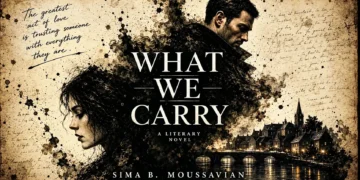
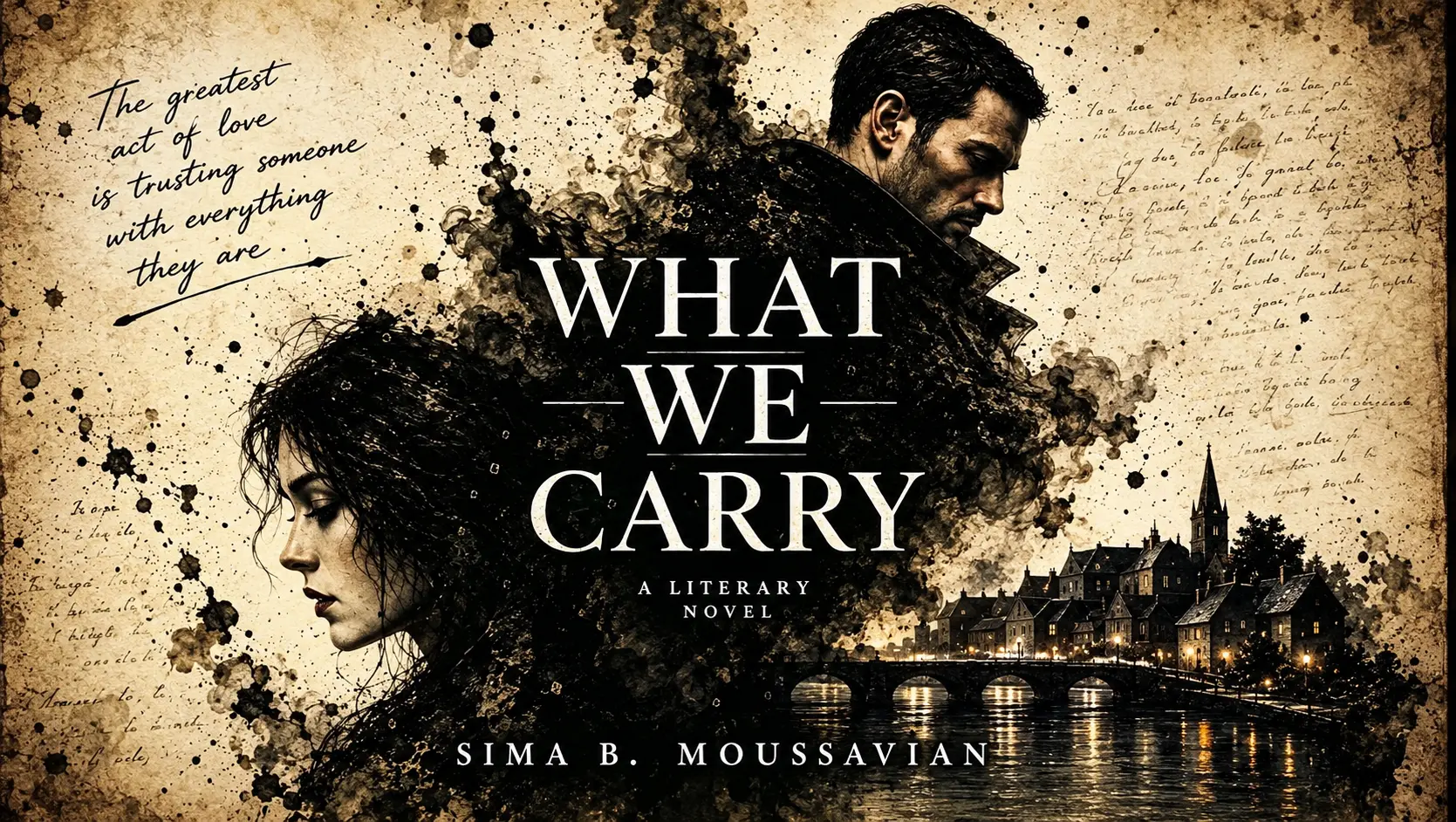
Sima B. Moussavian’s What We Carry, published in late July 2026, starts with a question that sounds academic: What happens to a people when their language disappears, but the world created by that language remains? Its protagonist, Samantha Wagner, is a linguist who travels to rural Ireland to investigate precisely that problem. But what begins as an inquiry into linguistic identity gradually becomes something stranger and darker: a meditation on memory, trauma, love, inherited stories and the uncomfortable possibility that the meanings we use to make sense of one another can become prisons.
The result is a novel that moves between literary fiction, psychological gothic, romance, philosophical speculation and metaphysical horror. Its first part, The Wor(l)ds Between Us, provides the intellectual and emotional foundation; What We Carry then pushes the questions much further, from the way language shapes individual identity to the danger of allowing one person, or one system, to decide what everyone else needs to believe.
The book’s opening premise is already characteristically Moussavian: “What if words don’t describe reality, but build it?”
That question matters considerably in 2026.
We live in an age in which arguments about words have become arguments about reality itself. Social media compresses complicated experiences into labels. Political and cultural communities increasingly construct identities around competing narratives. Artificial intelligence can generate apparently authoritative language at enormous speed, while people struggle to determine which words describe something real and which merely create the impression of reality. At the same time, migration and cultural change continually raise the question of what is lost when languages disappear, and what survives after them.
Moussavian’s novel does not offer an easy answer. It is more interested in the gap.
The world between words
Sam arrives in Ireland to study the relationship between language and identity. Her research begins with the idea that experience is shaped by the language through which it is understood. In the manuscript, she argues that “our way to experience the world changes with the language that is spoken.”
That concern comes directly from the author’s longstanding interest in linguistics. In a Goodreads interview about The Wor(l)ds Between Us, Moussavian explained that the story began with a question about whether a community that loses the language through which it once saw the world also loses part of itself. “Language is never just words,” she said, describing it as something that carries “memory, history, humour, grief” and ways of understanding people and places.
The Irish setting consequently becomes more than scenery. In Moussavian’s fictional world, language is inseparable from land, history and belonging. The novel’s treatment of Irish linguistic loss is tied to colonisation, but Moussavian eventually makes the argument more unsettling: perhaps the problem is not simply that one language replaced another. Perhaps language itself inevitably creates distance between people.
At one point Sam arrives at the conclusion that words are never the experience they attempt to convey. They are approximations, categories and containers. The attempt to communicate may therefore contain the seeds of its opposite: the possibility of misunderstanding.
That is where What We Carry becomes particularly contemporary.
We have more ways to communicate than any previous generation, yet misunderstanding has hardly disappeared. If anything, the novel asks, our abundance of communication may make the problem more visible. A message can travel around the world instantly while the experience behind that message remains inaccessible.
From The Wor(l)ds Between Us to What We Carry
Moussavian’s Goodreads interviews make clear that What We Carry grew out of the earlier conceptual territory of The Wor(l)ds Between Us. In one interview, she describes language as something that shapes thought, identity and emotional reality. In another, she says that the story became interested in what happens when a person is trapped inside a story that everyone else believes to be true.
That second idea is crucial.
The village in What We Carry is a place where stories harden into facts. An old incident involving Callen O’Grady’s brother Cathal becomes progressively transformed by gossip. People who were not present acquire increasingly confident versions of what happened. Every retelling adds certainty while removing ambiguity. Eventually, the community’s version of events becomes more powerful than the event itself.
Moussavian told Goodreads that this was central to Cathal’s character: his identity is ultimately shaped not simply by what happened, but by the story the community constructs around it.
It is a distinctly modern anxiety. Online, reputations can be built from fragments, allegations, screenshots, half-remembered incidents and repeated interpretations. Once a narrative becomes sufficiently familiar, people may cease to remember that it was ever a narrative.
The novel puts the problem more bluntly: “We tell stories about who we are” until we mistake those stories for truth.
Callen O’Grady and the seduction of being understood completely
If Sam represents the intellectual desire to understand, male protagonist Callen represents something more seductive: the desire to be understood without having to explain yourself.
He is the mysterious center of the Irish story, simultaneously protector, confidant, criminal, saviour and something increasingly difficult to classify. The published description of the novel captures his appeal: Callen seems able to understand Sam without her having to perform or explain herself.
But Moussavian is interested in the danger concealed inside that fantasy.
Callen knows what it means to protect people because he has spent his life carrying other people’s suffering. Yet protection gradually becomes indistinguishable from control. He can persuade people to surrender autonomy because he presents surrender as safety.
The manuscript eventually states the contradiction explicitly: the language of protection can conceal control, while domination can be reframed as responsibility.
This is one of the novel’s most striking contemporary ideas. The frightening question is not simply whether someone is controlling us. It is whether they can make control feel like care.
That question extends beyond romantic relationships. It reaches into families, communities, institutions and technologies. Who gets to decide what another person should be protected from? And at what point does helping someone become deciding for them?
Sam eventually articulates the distinction herself: knowledge and authority are not the same thing, even though Callen increasingly makes them difficult to separate.
Trauma as inheritance
The title What We Carry acquires its full meaning as the novel progresses.
Trauma in Moussavian’s world does not remain neatly inside the person who experienced it. It moves through families, communities and generations. Memory becomes both evidence and distortion. Grief becomes part of identity. Silence becomes an inheritance.
Goodreads currently lists among the book’s quotations one of its most succinct formulations: “Trauma spreads. Through people who never agreed to carry it.”
The novel’s own treatment of the O’Grady family illustrates that principle. Callen and Cathal inherit different versions of the same family history; their father carries his own grief into violence; the brothers then spend years living inside consequences neither can fully escape. Even a childhood memory of their mother becomes uncertain, raising the question of whether memory preserves the past or reconstructs it according to what we need from it.
Later, Sam reaches a more radical hypothesis: trauma may isolate people because it is experienced individually even though it is caused collectively.
That proposition gives the novel its ethical center. If suffering is shared in its origins but isolated in its consequences, perhaps the desire to heal cannot be entirely individual either.
Yet Moussavian refuses to make healing simple. Her supernatural “Current” is not a therapeutic shortcut. Entering it strips away language, memory and the familiar structures through which people understand themselves. What remains may be more authentic—or it may be nothing at all.
Why this book now
There is an obvious temptation, in 2026, to read a novel about language and meaning primarily through the lens of artificial intelligence. That would be too narrow, but it would also be difficult to ignore.
AI has made language simultaneously more powerful and less trustworthy. Machines can produce fluent explanations without possessing human experience. A perfectly grammatical sentence can still be false, empty or profoundly misleading. What We Carry repeatedly asks a related question: what happens when the form of communication becomes more persuasive than the experience underneath it?
Moussavian does not write an anti-technology novel. Her concern is more fundamental: humans have always confused words with the things words represent.
That makes the book’s central argument unexpectedly relevant to a world of algorithms, viral narratives and increasingly automated communication. The novel asks readers to slow down at precisely the moment modern communication encourages them to move faster.
What does someone actually mean?
What happened before the story about it was constructed? Whose version became the accepted one?
And who benefits when that version becomes permanent?
These questions are not confined to Ireland or to gothic fiction. They are questions about how human beings live together.
A striking early reception
The book’s reception is still extremely young, and that qualification matters. Goodreads currently records four ratings and three written reviews, all five-star ratings. The reviews were posted between September 29 and October 1, 2026.
The three early reviewers converge on several points without sounding identical. One reader praised the way language, meaning and identity are woven through Sam’s linguistic research and singled out the book’s questions about where protection ends and control begins. Another highlighted its atmosphere, mystery, romance and concern with being truly understood. A third praised the way the philosophical ideas are integrated into the character story rather than presented as detached intellectual exercises.
The third reviewer also observed that the novel is not necessarily a book to race through, describing it instead as a book that invites pauses and reflection. That response seems particularly apt for a novel whose central proposition is that understanding is never as straightforward as we assume.
It would be premature, however, to call these few reviews a broad critical reception. At this stage they constitute an encouraging early reader response, not a statistically meaningful consensus. That may change. The book has only just entered the world.
The unsettling question left behind
Moussavian’s own description of the novel ultimately reaches beyond language. The book, she writes, asks what happens when “the stories that hold us together begin to determine who we are allowed to become.”
That is perhaps the most important thing What We Carry carries.
It is not really asking whether stories are good or bad. Human beings cannot live without them. Stories give memory structure, allow communities to survive and give individuals a sense of continuity.
The danger begins when a story becomes unquestionable.
A language can preserve a culture, but it can also define the boundaries of belonging. A memory can preserve a relationship, but it can also imprison someone inside the past. Love can
become care, but care can become control. Protection can prevent suffering, but it can also become the justification for taking away someone’s freedom.
And words can connect us while simultaneously reminding us how much of another person’s experience we can never completely possess.
That is why What We Carry feels less like a novel about Ireland than a novel about the increasingly difficult problem of living together in a world where everyone carries a different version of reality.
Moussavian dedicated the book to “a nation lost in translation” and to the professor who introduced her to “the worlds that words create.”
The phrase could serve as the novel’s epigraph, and perhaps its warning. We are all living inside worlds made partly from words.
The question is what happens when we forget that we made them.