






















For the past few years the public conversation around artificial intelligence has been dominated by one question. Which jobs will AI replace? I think we are starting in the wrong place.
AI can already write reports, analyse documents, generate code, summarise meetings and answer customer questions. It performs work that once took people hours. From that, it is tempting to conclude that if enough individual tasks can be automated, the person doing the job eventually becomes unnecessary.
A job is a poor thing to reduce to a list of tasks, and this is where the usual argument starts to slip. A lawyer does not merely read documents. A doctor does not only analyse information. People work through sequences of decisions, conversations, exceptions and responsibilities. They deal with incomplete information, they persuade other people, they take responsibility when things go wrong, and they decide when a rule should be challenged. A lot of that never appeared in any procedure manual. That distinction matters.
The number that has been scaring everyone
Many studies on the impact of AI focus on what they call AI exposure. They examine the tasks performed inside an occupation and estimate how many of those tasks could be completed or accelerated with artificial intelligence. The studies are useful. The numbers are easy to misunderstand.
Imagine that AI can help with seven out of ten tasks associated with a particular job. It sounds as if 70 percent of the job can be automated. What if those seven tasks are only part of a larger process? Completing them may still depend on information from other people, on organisational permissions, on judgement, or on somebody being accountable for the final outcome. The picture changes quite fast once you look at it that way.
An AI system can be very capable at individual tasks and still be unable to perform the complete job on its own. This is what I call the exposure paradox. A job can have very high exposure to AI while remaining highly dependent on humans.
Two jobs. Same scary story. Completely different reality.
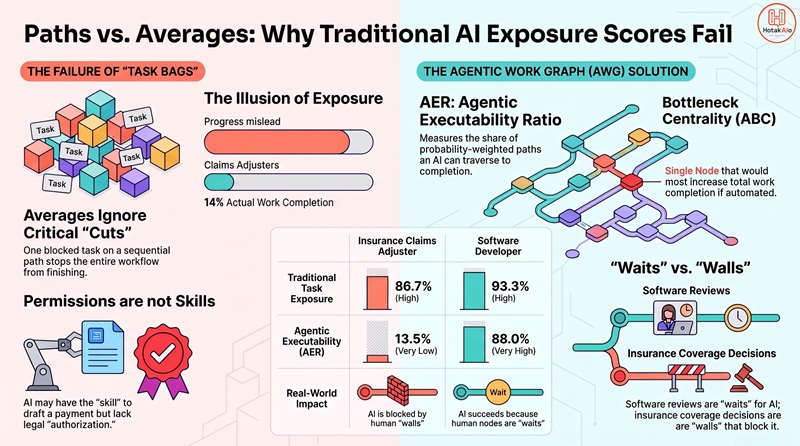
A lot of the discussion about automation still treats employment as if every occupation were a bag containing dozens of separate tasks. Take enough tasks out of the bag and eventually there is no job left. Real organisations do not work that way. Work happens through connected processes, and once you sit with a real file for a while you see it quite clearly, one person receives information from another, a decision creates a further task, that task may need approval from someone who was not in the first meeting, and an unexpected problem can send the whole process back several steps before anyone is willing to put their name on the final result.
The useful question, then, is whether an AI system can travel the entire path required to produce the outcome. That is a much harder standard than asking whether it can perform a single task.
I have been writing a research paper on this. I stop counting tasks as if they sat loose in a bag, and I follow the path a piece of work has to travel before anyone can say the work is finished.
Let us take two jobs that appear on almost every list of occupations highly exposed to AI. An insurance claims adjuster, from the first notice of a loss to a closed file. A software developer, from a ticket to a change that ships. If you only count tasks, both look wide open. In the simplified examples in the paper, about 87 percent of the adjuster’s tasks look exposed, and about 93 percent of the developer’s tasks look exposed.
Then you ask whether the machine can walk the whole path.
On the claims path the machine can finish only about 14 percent of the complete routes, because even if it drafts the letters and helps with the photos, the file still stops when the work reaches coverage or appraisal or negotiation, which are the points where a person has to make a judgement and then live with that judgement if it is wrong. On the software path it can complete about 88% of the routes. It can write the code and run the tests and wait for review. A person still approves the merge. That wait is part of how the job now works.
Same kind of headline, two different realities. These are teaching examples, they are not a census of the labour market. The old scores can rank two jobs as almost the same. The path does not.
An AI system might draft a legal document, and someone still has to decide what legal position the organisation should take. It might analyse a patient’s information, and someone still takes responsibility for a difficult clinical judgement. It might generate a financial recommendation. Who understands the political or commercial consequences around that decision? It might write software, and someone still has to determine whether the system should be built at all. People sometimes treat these as small details around the edge of the job. In practice they occupy most of the real responsibility.
This is not a lullaby
I am not arguing that employment stays untouched. Many jobs are going to change, some of them quite sharply. Some tasks will disappear. Others will become almost effortless. Work that once took several days may take several hours. One employee may produce what previously required a small team, and entire processes will be redesigned. Some roles will disappear where the work is predictable enough, repeatable, and easy to verify.
For a large part of the workforce, the bigger change will be job redesign rather than job destruction. The person remains. The reason the organisation needs that person changes. Routine production becomes less important, judgement starts to carry more of the job. Knowing how to find information becomes less valuable than knowing what to do with it. Supervising and challenging intelligent machines becomes part of ordinary professional work, the way using a spreadsheet already is.
If you can take a decision when the information is incomplete, and you can tell when the machine is confidently wrong, the organisation still needs you. The reason it needs you may look different from the reason it needed you ten years ago. I find that a more useful way to think about hope than another speech about people and machines working together.
Companies are asking the cheap question
If an organisation treats AI mainly as a headcount-reduction exercise, it can miss the larger opportunity. The better question is how work should be redesigned now that machines can perform parts of it. That means looking at complete processes, not isolated tasks. Where does human judgement actually matter? Where are people spending time simply moving information from one system to another? Which decisions could be given to AI, and which ones should stay with a person? Where should a human review an action the machine has already produced? When the workforce becomes more productive, should the organisation reduce capacity, or use that capacity to do things it could never afford before?
A claims department can buy software for photo estimates and then wonder why the close rate did not move, if coverage still needs an adjuster. A software team can let the machine write the patch and still wait in a review queue. I keep seeing firms buy tools for the easy part of the path and then look surprised when the outcome does not move. The machine did what it was asked. The process was the problem.
The future is already inside the job
“Humans and AI will work together” has become a sentence people repeat until it means almost nothing. The reality will be more disruptive than that sentence suggests. AI will change the boundaries of jobs, and it will change which skills get paid. Organisations may need fewer layers. Managers will manage something different from what they manage now. Companies will have to look again at jobs designed decades before these systems existed.
People like to describe this as a battle between humans and machines. I find that picture less useful than what is already happening inside the job itself. AI is breaking jobs apart and forcing us to decide which parts should belong to machines and which parts still require a person who can be asked whether the call was right.
I would rather organisations spend the next two years on that question than on another league table of job titles, including here in London. Some titles will drop out anyway. A lot of the rest will stay and start to look unfamiliar.
The research behind this argument is in my paper, Beyond AI Exposure Scores. In plain language it is an attempt to move from bags of tasks to the paths that actually finish the job.
About the Author:
Alham Hotaki is a British independent researcher in artificial intelligence and data science. He has spent more than 15 years in technology and in public-sector reform, including e-governance programmes with the World Bank, JICA (the Japan International Cooperation Agency) and the Government of Afghanistan. He has led AI work inside HSBC, Deutsche Bank, AON and the UK Care Quality Commission. Those systems went into production in financial services, cybersecurity, compliance, workforce analytics, healthcare and telecommunications. He writes on agentic systems, AI governance, and the redesign of professional work.