






















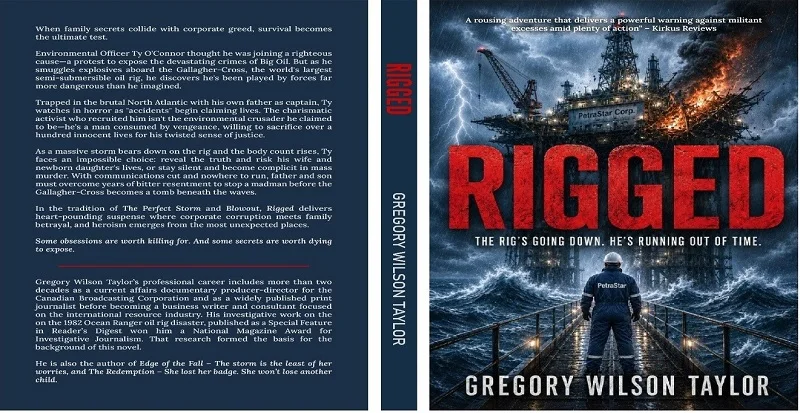
Gregory Wilson Taylor’s novel RIGGED does not present an offshore drilling unit as a routine workplace. It shows it as a sealed pressure cooker where secret agendas, family blood, and carefully hidden explosives turn every decision into a potential catastrophe.
The Closed World Where Secrets Have Nowhere to Hide
Once the crew is isolated on the Gallagher-Cross, the largest semi-submersible oil rig in the North Atlantic, ordinary shore life disappears. Men share cabins, eat in the same galley, and walk the same steel corridors for weeks. In that confined space a new face is instantly measured. A bright red suitcase that looks too clean. An Environmental Officer who answers questions a little too carefully. A cook who suddenly becomes a target. What begins as a standard crew change quickly reveals itself as something far more dangerous: a man carrying thirty pounds of Semtex, a father and son trapped in the same floating steel maze, and a revenge plot years in the making.
Why the Real Numbers Are Measured in Lives, Not Dollars
The captain can recite the operating cost—one point four million dollars a day, fifty-eight thousand every hour—but the true price is paid in blood and fear. Those monetary figures sit inside every decision, yet they become secondary the moment antifreeze is poured into a fuel line, a remote detonator is armed, or a rifle is raised on a storm-lashed deck. The platform is judged by what it produces, but the men who walk its decks know that one wrong move can send the entire structure past the point of recovery.
Key pressures that shape every hour include:
- The knowledge that a single act of sabotage can cripple the generators and leave the rig listing in a North Atlantic gale
- The quiet understanding that some men aboard are not who they claim to be
- The growing certainty that the next blowout or explosion may be the last
- The shared fear that the sea will claim them all before help can arrive
How the Role of Oversight Becomes a Perfect Cover
An Environmental Officer arrives with a title that already sets him slightly apart. On paper the job is clear: prevent spills, enforce rules, keep the company inside the lines. On the Gallagher-Cross, those duties become the ideal disguise. Some men see a source of friction. Others hear a possible threat. The difference is never fully spoken. It appears in short comments, in the way certain topics are raised, and in the careful measurement of any new face that carries both official responsibility and a private mission.
The Practical Weight of Danger in an Unforgiving Setting
Safety talks open every new stretch of work. Wear the proper gear. Cold-water survival times are stated without softness. The North Atlantic does not offer second chances. Yet the real threats are never listed in the manuals: a bomb placed under a friend’s bunk, a sabotaged lifeboat, a deliberate blowout, communications cut, and generators poisoned with glycol. A person learns quickly that the listed rules are not theoretical. They are the thin line between a controlled day and a sudden irreversible event. At the same time the work itself must continue. The tension between survival and production never fully disappears—until the production itself is the target.
What Personal Histories Bring Into a Shared Industrial Space
Every man on the platform carries something from earlier years. A captain haunted by a previous blowout that killed a friend. A son who once watched villagers massacred in West Africa and still carries the unprocessed guilt. A radical who has decided the only way to make the industry listen is to put every life on board at risk. Those histories do not appear on official forms. They are revealed in the way a person watches a system, the way he answers a question, or how he keeps certain thoughts private. The platform does not ask for those stories. It only asks for reliable work. Yet the stories remain present and shape decisions that can kill.
Where the Gap Between Official Duty and Private Mission Explodes
The listed responsibilities are clear. Watch for waste. Guard against spills. Keep operations inside tight and proper. A person can perform those duties with care and still feel a larger question sitting just beyond the edge of the shift. On the Gallagher-Cross, that question is no longer abstract. It becomes concrete the moment the Semtex is stolen, “accidents” proliferate, and a father and son must decide—under fire and in a rising gale—whether blood is thicker than ideology. The official role does not require the larger question. The private mission does. The two pull against each other until the only remaining choice is who lives and who dies.
How the Platform Continues While the Real Battle Is Fought in Secret
The drill keeps turning. Supply boats arrive and leave. Weather shifts and the crew adjusts. The structure itself does not pause to consider the private calculations that travel with certain members of the crew. It simply continues its work. The sea continues. The demand for production continues. A man who carries both the official duty and a private plan of sabotage is left to walk the same decks with both loads present at once—until the moment his plan is no longer private and the platform itself becomes the weapon.
The novel leaves the reader with a clear sense that the real weight of offshore work is never only technical. It is human, driven by guilt, rage, loyalty, and the secrets men carry into a place where there is nowhere left to hide. On the Gallagher-Cross, those secrets do not stay quiet. They explode.