























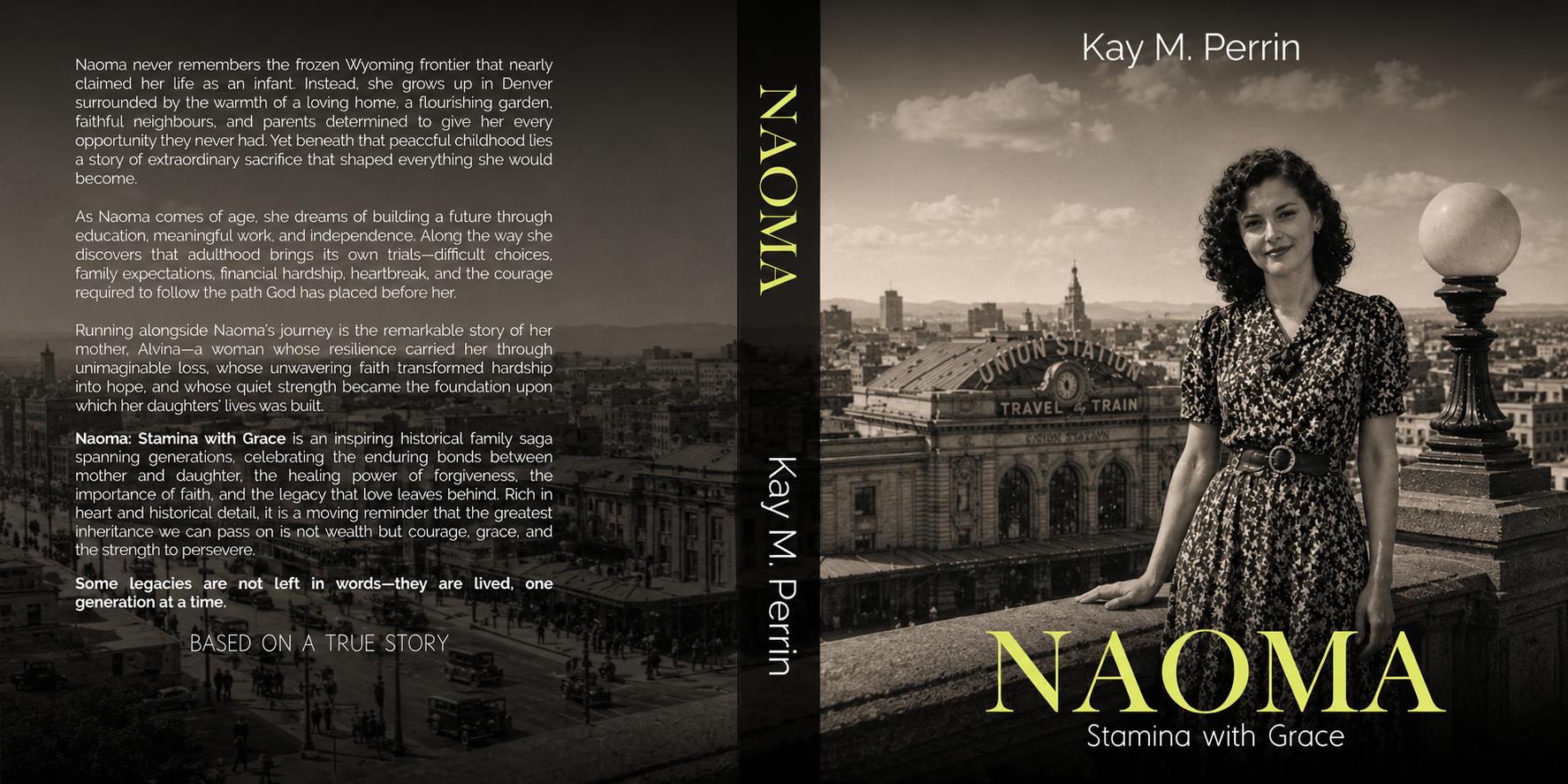
There are moments that split a life in two. For Naoma Hursting, that moment arrived on a quiet Sunday in December 1941. In Naoma: Stamina with Grace, Kay Marie Perrin captures the instant when everything Naoma had begun to trust disappeared and the long, quiet courage it took to keep living afterward.
The novel continues the multi-generational story begun in Alvina: Strong and Determined. Readers who followed Alvina’s frontier survival now walk with her daughter through the Great Depression and into the early years of World War II. Naoma has already learned hard lessons. Raised by a mother who faced isolation, hunger, and the daily demands of the Wyoming prairie, she understands that survival is built from small, steady acts. In Denver during the Depression, those lessons become practical. She sets aside her dream of becoming a nurse so she can help keep her family going. Hope returns when she falls in love with Eddie, a kind and steady man who makes a different future feel possible.
Then Pearl Harbor changes everything.
The attack that stunned the nation reaches straight into Naoma’s private world. The man she planned to marry is gone. In a single morning the life she had started to build collapses. The grief is immediate and complete. Perrin does not soften the blow or rush past it. She stays with Naoma in the raw aftermath the empty space where plans once lived, the questions that have no answers, and the heavy silence that follows sudden loss.
What follows is not a story of quick recovery. It is a portrait of someone learning how to carry heartbreak without being destroyed by it. Naoma draws on the same quiet strength her mother once modeled. She gets out of bed. She tends the garden. She shows up for the family that remains. She refuses to let the cost of love erase the decision to keep living. Grace, the novel suggests, is not the absence of pain. It is the repeated choice to continue when the future feels stripped bare.
Perrin places this personal tragedy firmly on the American home front. While the larger war filled newspapers and radio broadcasts, women like Naoma carried private sorrow alongside the practical burdens of daily life. Their endurance rarely made headlines, yet it sustained households through years of national crisis. By focusing on one woman’s interior journey, the book restores dignity to that often-invisible work.
Because the story is rooted in the author’s family history, the sense of lived truth runs deep. The transmission of resilience from Alvina to Naoma feels earned. Readers sense they are witnessing more than fiction; they are seeing the quiet legacy of real women who refused to stop showing up when everything seemed lost.
The novel ultimately asks a question that reaches beyond its historical setting. What do you do when the life you planned is taken away? Naoma’s answer is not dramatic defiance. It is the steady practice of ordinary courage of caring, of remembering, and of choosing life even on the hardest days. That choice defines her journey and gives the book its lasting emotional power.
Naoma: Stamina with Grace reminds us that history is shaped not only by battles and headlines but by the people left behind who keep going anyway. Naoma’s heartbreaking moment is the beginning of her deepest strength. For readers who value character-driven historical fiction and stories of quiet resilience, her story will stay with you long after the final page.