























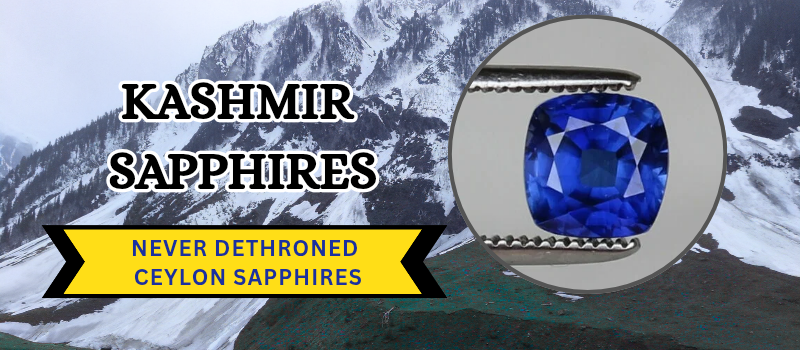
Kashmir sapphires occupy a legendary position in the world of gemstones. Their velvety cornflower blue color, soft luster, and historical mystique have made them some of the most coveted sapphires ever discovered. Auction records and collector demand consistently place fine Kashmir sapphires among the most expensive colored gemstones in the world. However, despite this legendary appeal and their commanding prices, Kashmir sapphires have never truly dethroned Ceylon sapphires in terms of overall dominance, availability, and long-term influence on the global sapphire market. The reasons for this are rooted in geology, history, economics, and accessibility.
FIRST KASHMIR SAPPHIRE FIND
The original Kashmir sapphire deposits were discovered in the late 19th century in the Padar region of Kashmir, near the Zanskar range. This first discovery site, which produced the finest quality Kashmir sapphires, was geologically limited. The output of gem-quality rough sapphire from this location was never large, and the mining period was relatively short. The legendary Zanskar Crown Sapphire and the Spirit Of Kashmir Sapphire, are reported to have been extracted from this first mining location.
Once these deposits were exhausted, no subsequent discovery in the region matched the quality, consistency, or volume of the original mine. As a result, the supply of true top-grade Kashmir sapphires has always been extremely restricted. This scarcity has fueled their legendary status but has also constrained their ability to dominate the broader sapphire market.
CEYLON BLUE SAPPHIRES
In contrast to the low volume resource in the initial location mining Kashmir sapphire, Sri Lanka, historically known as Ceylon, has been producing sapphires for over two thousand years. The island’s gem-bearing gravels have yielded an extraordinary range of sapphire colors and qualities, with blue sapphires being among the most important. Unlike Kashmir, Sri Lanka’s sapphire resources are extensive and geologically diverse. New material continues to be recovered, ensuring a steady and reliable supply of sapphires for the global market. This continuity has allowed Ceylon sapphires to establish a lasting presence across generations of jewelers, collectors, and consumers. One of the legendary Ceylon sapphires happens to be, the blue Ceylon sapphire set in the famed engagement ring worn by the late Lady Diana a British Royal.
PRICING KASHMIR AND CEYLON SAPPHIRES
Another important factor is pricing of blue sapphires from the two locations. Fine Kashmir sapphires are priced at levels that place them firmly in the realm of elite collectors, museums, and high-end investors. Their value is driven as much by rarity and historical provenance as by beauty. Even smaller Kashmir sapphires with verifiable origin can command prices that exceed those of much larger Ceylon sapphires. This pricing structure makes Kashmir sapphires largely inaccessible to general jewelry buyers and gem enthusiasts. They are no longer gemstones for everyday fine jewelry but rather trophies for those with very high acquisition budgets.
Ceylon sapphires, while certainly not inexpensive, occupy a much broader price spectrum. Exceptional Ceylon blue sapphires with fine color and clarity can be expensive, but they are still generally priced more reasonably than comparable Kashmir stones. At the same time, Sri Lanka produces sapphires in commercial to fine qualities that remain accessible to a wide range of budgets. This inclusivity has helped Ceylon sapphires maintain a strong position in both high jewelry and mainstream fine jewelry markets. Jewelers can confidently design with Ceylon sapphires knowing that supply, size options, and price flexibility are available.
Market perception also plays a role. Kashmir sapphires are often spoken of in reverent terms, but their rarity means that few buyers ever encounter them firsthand. For many jewelry lovers, Kashmir sapphires exist more as a legend than a practical choice. Ceylon sapphires, on the other hand, are widely recognized, worn by royalty, celebrities, and private individuals alike. They have been featured in iconic jewelry pieces for centuries, reinforcing their status as the most recognizable and trusted source of fine sapphires. An example is the Zanskar Crown Sapphire, which was once worn in a luxury necklace worn by Maharaja Pratap Singh, the ruler of Kashmir.
From a commercial standpoint, the gemstone and jewelry industry thrives on continuity and reliability. Ceylon sapphires fulfill these requirements far better than Kashmir sapphires. With consistent production, established cutting centers, and a long history of trade, Sri Lanka remains a cornerstone of the sapphire market. Kashmir sapphires, due to their extreme scarcity, cannot meet the needs of designers, retailers, or even most high-end jewelers on a regular basis. As a result, they remain a niche category rather than a market-shaping force.
Another key consideration is competition. The rarity of Kashmir sapphires continues to increase as existing stones are absorbed into private collections and long-term holdings. This effectively removes them from circulation. With fewer stones available for trade, competition between Kashmir and Ceylon sapphires is minimal.
DIFFERENT MARKET SEGMENTS
Rather than competing directly, the two occupy very different market segments. Kashmir sapphires cater to collectors seeking historical significance and rarity, while Ceylon sapphires serve a global audience that values beauty, durability, and availability.
In this context, it becomes clear why Kashmir sapphires have never dethroned Ceylon sapphires. Dominance in the gemstone world is not determined solely by price or prestige, but by sustained influence, accessibility, and market presence. Ceylon sapphires continue to meet these criteria, facing little practical competition from Kashmir sapphires today. With no meaningful new production expected from Kashmir, this balance is unlikely to change in the foreseeable future.
RELATED INFORMATION
Zanskar Crown Sapphire
The Zanskar Crown Sapphire is one of the highly talked about Kashmir blue sapphires. Originating from the historic Kashmir deposits near the Zanskar range, the gemstone is admired for its rich, velvety blue color and exceptional translucency. It represents the finest characteristics associated with classical Kashmir sapphires and is often cited as a benchmark for collectors and gemologists studying historic blue sapphires. Reports suggest that, Maharaja Pratap Singh of Kashmir, wore the big cushion cut Kashmir sapphire in a scintillating necklace.
Spirit of Kashmir Sapphire
The Spirit of Kashmir Sapphire is another legendary gemstone that exemplifies the mystique and rarity of true Kashmir sapphires. Known for its deep yet soft blue hue and remarkable internal glow, the stone embodies the romantic and historical allure of Kashmir sapphire mining. It is frequently referenced in discussions of iconic sapphires due to its provenance and extraordinary quality.