























Brussels presents greater mobility as an answer to Europe’s skills shortages. But without a public assessment of the impact on wages and employment, workers are being asked to take the benefits on trust, and bear the risks themselves.
When European Commission President Ursula von der Leyen hailed the EU-India Comprehensive Cooperation Framework, signed in January, as a “historic milestone” for expanding global partnerships and addressing Europe’s skills gaps, Brussels celebrated the promise of closer cooperation. Across European professional forums, social media groups and public discussion boards, however, a more immediate question was taking hold: before opening the door to greater talent mobility, has the EU properly assessed what this could mean for jobs and wages at home?
“Very good for the rich. Terrible for us mere mortals. Our already-low salaries will be further decreased and it will be harder to get a job.” Such reactions are easy to dismiss as online frustration. They should not be. One industry professional described what they had witnessed first-hand: “I already know a few companies in North Italy have hired seniors and team leads from India for 45k-50k, which is on the lower side of the salary distribution for those roles.” Others point to Canada as a warning: “This happened in Canada. From 2022-2024 probably 1M+ Indians arrived. Wages went down. Rents went up.”
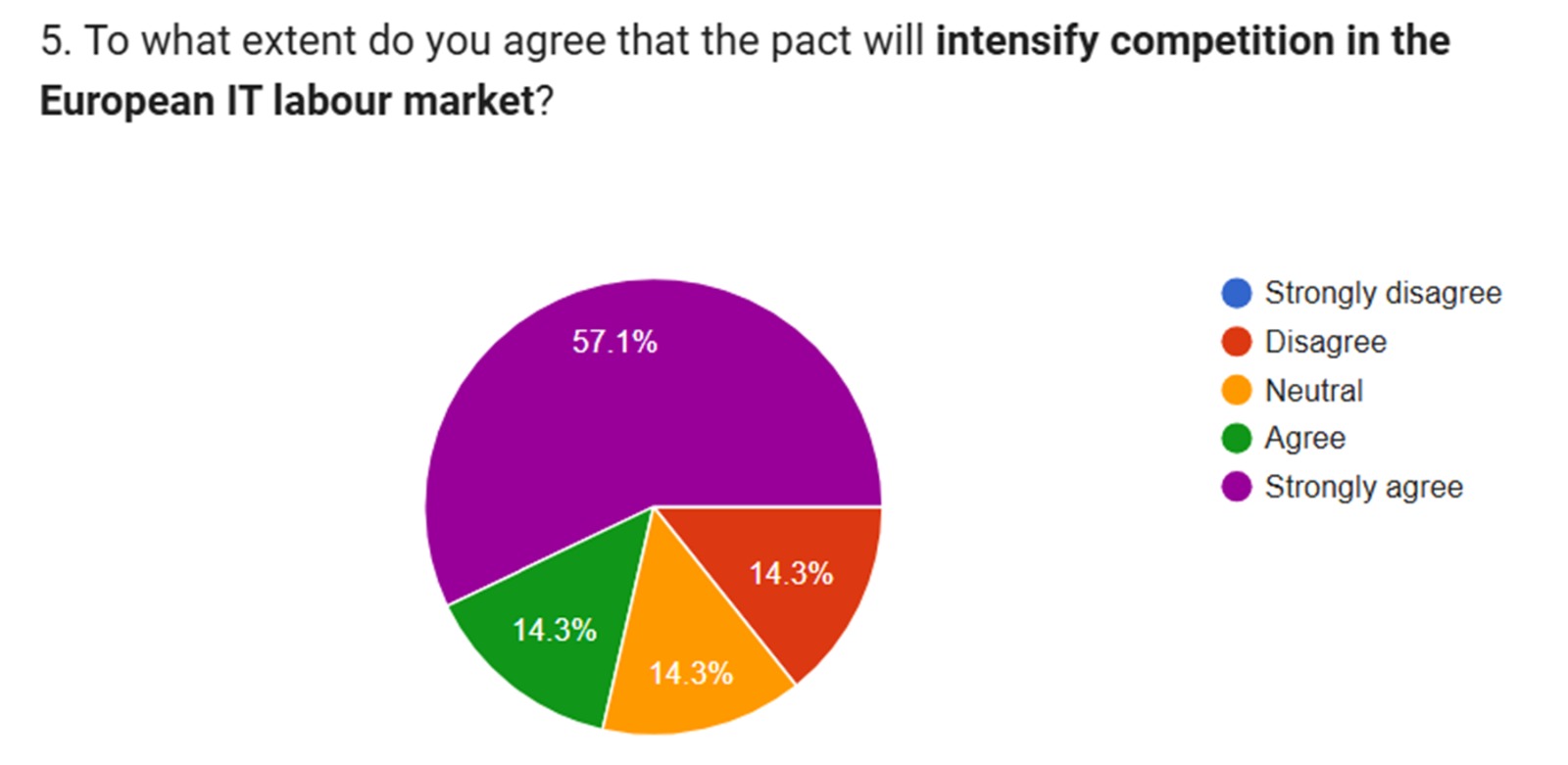
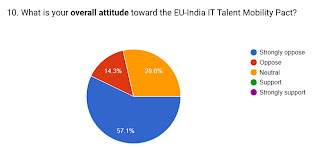
A survey of students, graduates and professionals working in Europe’s information and communications technology sector reflects the same unease: 57% believe the deal will significantly increase competition for jobs; the same proportion expects downward pressure on graduate starting salaries; and 57% say their own career prospects will be negatively affected. Many respondents expressed the concern in blunt terms: “There are no vacancies to fill.” For people already trying to enter or remain in the labour market, talent mobility is not necessarily seen as matching workers with available roles. It is seen as adding more candidates to a pool in which opportunities are already scarce. These voices are not rejecting international cooperation. They recognise that Europe needs skills. Their fear is that, without robust evidence or safeguards, greater openness will come at the expense of workers already here.
That concern goes to the heart of a provision that has received remarkably little attention in official EU communications. In Brussels, the agreement – covering trade, investment and technology – has been presented primarily as a strategic tool to boost competitiveness and address demographic decline. Speaking at the signing ceremony in New Delhi, von der Leyen said the mobility arrangements would “fully align with the needs and policies of member states” and pave the way for India’s participation in flagship EU research programmes. Yet, as analyst Carl Deconinck has noted, the two sides have sold the deal very differently. Indian officials have repeatedly highlighted “uncapped mobility” as a core achievement, opening pathways for students, researchers and skilled professionals. EU statements, by contrast, have placed mobility behind trade liberalisation, supply-chain resilience and the energy transition, offering almost no detail on its scale, scope or possible labour-market effects.
That lack of clarity has already drawn scrutiny from the European Parliament. On 29 January, MEPs Charlie Weimers, Beatrice Timgren and Dick Erixon tabled a written question asking what assessment the Commission had carried out, before making these commitments, of the likely impact on employment, wage structures and access to work within the EU. They also asked what concrete mobility commitments had been made, when they would be implemented, and how their effects would be monitored and the relevant rules enforced.
On 19 March, the Commission issued its formal reply. It confirmed that the accompanying Memorandum of Understanding is non-binding, that member states retain authority over admission numbers, and that implementation will take place within existing EU and national law. It also said the pilot European Legal Gateway Office would operate for 26 months, initially focusing on ICT, and that migration flows would be monitored through established channels, including Frontex. But on the central question – whether any ex ante assessment of the labour-market effects had been conducted – the Commission did not provide a direct answer. No study was cited. No findings were presented. No explanation was offered for moving ahead without putting such analysis on the public record. For critics, that omission is not a technical detail. It is the core of the problem: a policy with consequences for jobs, wages and livelihoods is advancing without a transparent account of how its risks and benefits were weighed.
The broader trends are already clear. By 2021, more than 600,000 Indian nationals were legally resident in the EU. In 2022 alone, member states issued more than 180,000 first residence permits to Indian citizens, who now constitute the largest group of non-EU recipients of EU Blue Cards for highly skilled workers. Projections suggest that India could add some 245 million high-skilled workers to its labour force by 2030. For ageing European economies, that represents a potentially valuable source of talent. For workers facing weak wage growth, insecure employment and intense competition, it is also a legitimate source of anxiety.
The real divide is not between those who support global talent and those who oppose it. It is between those who believe mobility should be expanded first and assessed later, and those who insist that openness must be matched by responsibility. The Commission’s economic argument is straightforward: as birth rates fall and vacancies persist, international skills are essential to sustaining industry and growth. But opponents are equally entitled to ask whether an expanded labour supply could weaken workers’ bargaining power over pay, particularly in mid- to high-skilled sectors, while allowing governments and employers to postpone investment in domestic training and upskilling.
“We do not dispute the deal’s potential upside,” said a senior researcher at a Brussels-based labour-market think tank. “But decisions must withstand basic scrutiny: have leaders been open about what they know, and what they do not? Is there robust evidence to back their choices? As the driving political force behind this agreement, President von der Leyen owes the public that clarity. Strategic vision is no substitute for risk assessment – and openness must be paired with fairness.”
To date, the Commission has provided no further clarification on the questions left unanswered in its response to Parliament, nor has it published a dedicated labour-market impact assessment. With the first European Legal Gateway Office set to open and the mobility provisions due to take effect, that absence is becoming harder to defend. Europe may well need more international talent. But no major policy affecting people’s jobs, wages and livelihoods should be implemented on the basis of optimism alone. Before asking workers to accept the risks, Brussels must show that it has measured them.